
Nvidia Unveils Revolutionary Self-Driving Car Platform to Bring "Reasoning" to Autonomous Vehicles
- Iven Forson
- Jan 7
- 4 min read

Nvidia, the world's leading chip-maker and most valuable publicly traded company, has launched a groundbreaking technology platform designed to give self-driving cars the ability to "think" and reason through complex driving scenarios.
The announcement, made at the annual CES technology conference in Las Vegas, marks a significant shift for the company as it moves beyond powering AI software like ChatGPT to embedding artificial intelligence into physical products like autonomous vehicles.
The new platform, called Alpamayo, represents what Nvidia CEO Jensen Huang described as a "profound shift" in how autonomous vehicles operate.
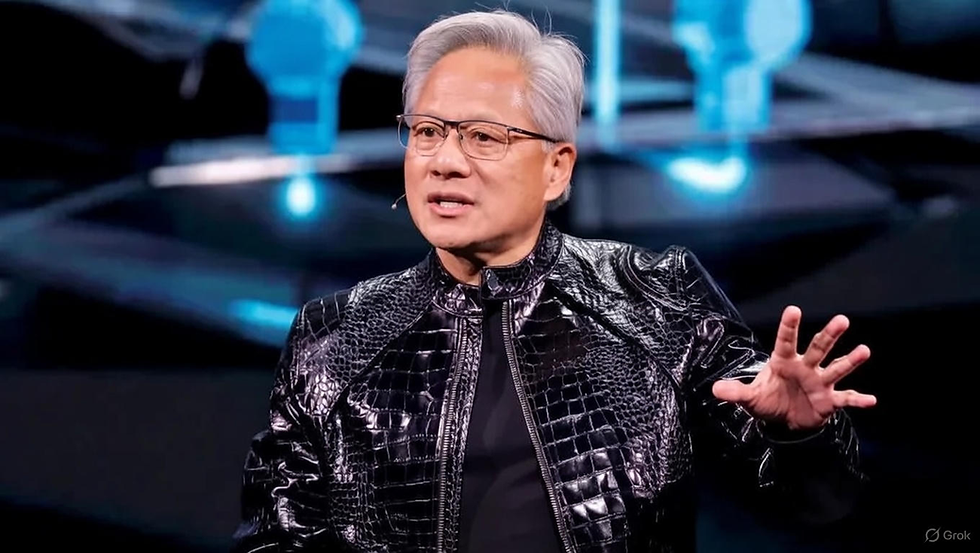
Speaking to hundreds of attendees while sporting his trademark black leather jacket, Huang explained that Alpamayo would enable cars to "think through rare scenarios, drive safely in complex environments, and explain their driving decisions."
In simpler terms, this means self-driving cars powered by Alpamayo won't just follow pre-programmed rules—they'll actually reason through situations the way a human driver would, making split-second decisions based on understanding rather than just pattern recognition.
What makes Alpamayo revolutionary is how it learns. Rather than being programmed with millions of "if-this-then-that" instructions, the system learns directly from watching human drivers navigate real-world situations.
Nvidia demonstrated this capability with a video showing an AI-powered Mercedes-Benz driving autonomously through the busy streets of San Francisco. A passenger sat behind the steering wheel with hands in their lap while the car smoothly navigated traffic.
"It drives so naturally because it learned directly from human demonstrators," Huang explained. "But in every single scenario, it tells you what it's going to do, and it reasons about what it's about to do."
This "reasoning" capability sets Alpamayo apart from current self-driving systems that primarily rely on sensor data and pre-programmed responses.
Nvidia announced it's partnering with Mercedes-Benz to produce the first driverless car powered by Alpamayo technology. The vehicle will launch in the United States in the coming months before expanding to Europe and Asia.
"Our vision is that someday, every single car, every single truck, will be autonomous," Huang told the audience, outlining an ambitious long-term goal.
The company also revealed plans to launch a robotaxi service by next year in collaboration with an unnamed partner, though details about the location and partner remain undisclosed.
In a move that could accelerate autonomous vehicle development globally, Nvidia made Alpamayo an open-source AI model. The underlying code is now available on Hugging Face, a machine learning platform where autonomous vehicle researchers can access it for free and customize it for their own projects.
This democratization of the technology could enable smaller companies and research institutions—including those in developing markets like Ghana and across Africa—to develop their own autonomous vehicle solutions without starting from scratch.
Nvidia's announcement puts it in direct competition with Elon Musk's Tesla, which has long dominated the autonomous driving conversation with its Autopilot driver assistance software.
Musk quickly responded on social media, acknowledging the similarity to Tesla's approach but warning about challenges ahead. "What they will find is that it's easy to get to 99% and then super hard to solve the long tail of the distribution," Musk posted, referring to the difficulty of handling rare edge cases.
Paolo Pescatore, analyst at PP Foresight, views Nvidia's move as strategically brilliant. "NVIDIA's pivot toward AI at scale and AI systems as differentiators will help keep it way ahead of rivals," he said from Las Vegas. "Alpamayo represents a profound shift for NVIDIA, moving from being primarily a compute to a platform provider for physical AI ecosystems."
Huang proclaimed that "the ChatGPT moment for physical AI is almost here," suggesting that autonomous vehicles are about to experience the same revolutionary leap that conversational AI did with ChatGPT's launch.
While AI has dominated headlines for powering software applications—from chatbots to image generators—tech giants are increasingly focused on embedding intelligence into hardware: robots, vehicles, manufacturing equipment, and consumer devices.
Nvidia's chips have been the engine powering the AI revolution, but the company is now positioning itself to control both the brain (chips) and the nervous system (software platforms) of intelligent machines.
Beyond autonomous vehicles, Nvidia announced that its Rubin AI chips are currently being manufactured and will be released later this year.
These highly-anticipated processors can compute using less energy than Nvidia's current chip lineup, potentially driving down the cost of developing AI technology—a critical factor for adoption in price-sensitive markets.
Nvidia shares rose slightly in after-hours trading following Huang's presentation, reflecting investor confidence in the company's strategic direction.
With a market capitalization exceeding $4.5 trillion (£3.3 trillion), Nvidia briefly became the first company to reach $5 trillion in October. Though it has lost some value amid concerns about whether AI demand is overhyped, the company remains the world's most valuable publicly traded corporation.
While autonomous vehicles may seem distant from African roads, the technology's open-source nature presents intriguing possibilities for the continent.
African cities face unique transportation challenges—from chaotic traffic patterns to inadequate public transit systems. Autonomous vehicle technology, adapted for local conditions, could revolutionize urban mobility in cities like Accra, Lagos, and Nairobi.
The open-source model allows African tech innovators and universities to experiment with and adapt the technology for local needs without prohibitive licensing costs. Ghana's growing tech ecosystem, centered in Accra's tech hubs, could potentially develop autonomous solutions tailored to African road conditions and transportation challenges.
Moreover, as energy-efficient chips like the Rubin become available, the cost barrier for AI development decreases, making it more feasible for African startups to build AI-powered solutions for local problems.
Despite the excitement, significant hurdles remain. As Musk noted, achieving near-perfect performance is one thing; handling the infinite variety of rare real-world scenarios is exponentially harder.
Regulatory frameworks for autonomous vehicles remain undeveloped in most countries, including across Africa. Infrastructure requirements—from road markings to connectivity—also present challenges, particularly in developing markets.
Questions about liability, cybersecurity, and job displacement for professional drivers will need addressing before autonomous vehicles achieve widespread adoption.
The coming months will reveal whether Nvidia's ambitious vision translates into real-world success. The Mercedes-Benz launch in the US will be closely watched as a test case for the technology's readiness.
For the global tech community, including Africa's growing innovation hubs, Alpamayo's open-source availability represents an opportunity to participate in shaping the future of transportation rather than merely consuming technology developed elsewhere.
The race toward fully autonomous vehicles is accelerating, and Nvidia has just signaled it intends to lead the pack—not just by providing the chips that power AI, but by defining how intelligent machines operate in the physical world.



Comments